Why does a garden that works in summer fall flat in winter?
Most gardens are planned and bought in spring and summer, when everything is in leaf and flower. The planting that carries the garden in June is often the planting that disappears in November: perennials cut back, bedding lifted, deciduous shrubs bare. What remains is the paving, the lawn and whatever happens to be evergreen, and that is rarely enough to hold the eye.
The months that follow are long ones to look at an empty garden. The Met Office notes that on the winter solstice daylight lasts just 7 hours and 50 minutes, almost nine hours less than the longest day in summer. In those short days, much of a garden is seen from indoors, through a window, often in low light. That is the view worth designing for.
What gives a garden interest in winter?
The RHS guide to plants for winter interest lists the sources plainly: flowers, scent, berries, coloured stems or dramatic evergreen foliage. It adds a point that suits containers well. Some winter plants are not particularly attractive in summer, so it can be useful to grow them in containers and change plantings with the seasons, and plants with fragrance are best placed by doorways and entrances in regular winter use.
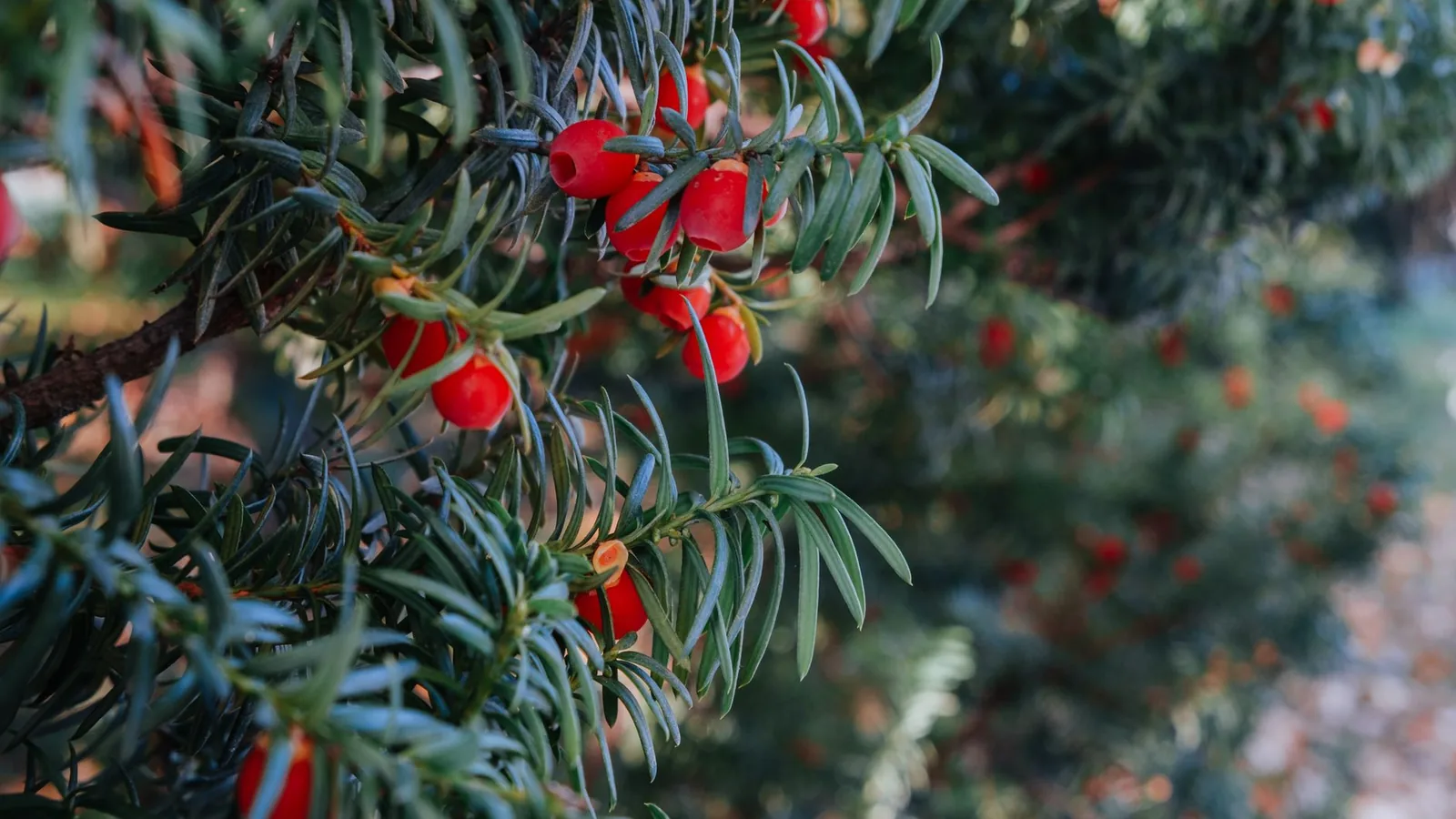
Structure matters most. The RHS tree growing guide notes that trees which keep their leaves retain a consistent appearance throughout the year and are great for winter interest. Its conifer growing guide describes conifers as adding valuable structure and colour, especially on darker winter days, and notes that some, such as Cryptomeria japonica, take on reddish hues in winter.
Which elements carry a composition through winter?
We think of a winter composition in layers, each doing a different job.
| Layer |
What it gives in winter |
Examples from the RHS guides |
| Evergreen structure |
Outline and mass that stay constant |
Upright yew, conifers, box and bay |
| Bark and form |
Texture and colour once leaves fall |
Acer griseum, whose bark flakes back to show cinnamon beneath |
| Scent and flower |
Something to notice at the door |
Sarcococca, witch hazel, Helleborus niger |
| Seasonal colour |
Change through the year |
Conifers that take on reddish hues in winter |
The RHS guide to trees for smaller gardens describes Acer griseum as a small tree with bark flaking and curling back to reveal cinnamon coloured bark beneath, the kind of detail that is easy to miss in August and hard to ignore in January. The same guide suggests that where there is room for only one tree, it should ideally offer more than one season of interest.
How do containers help?
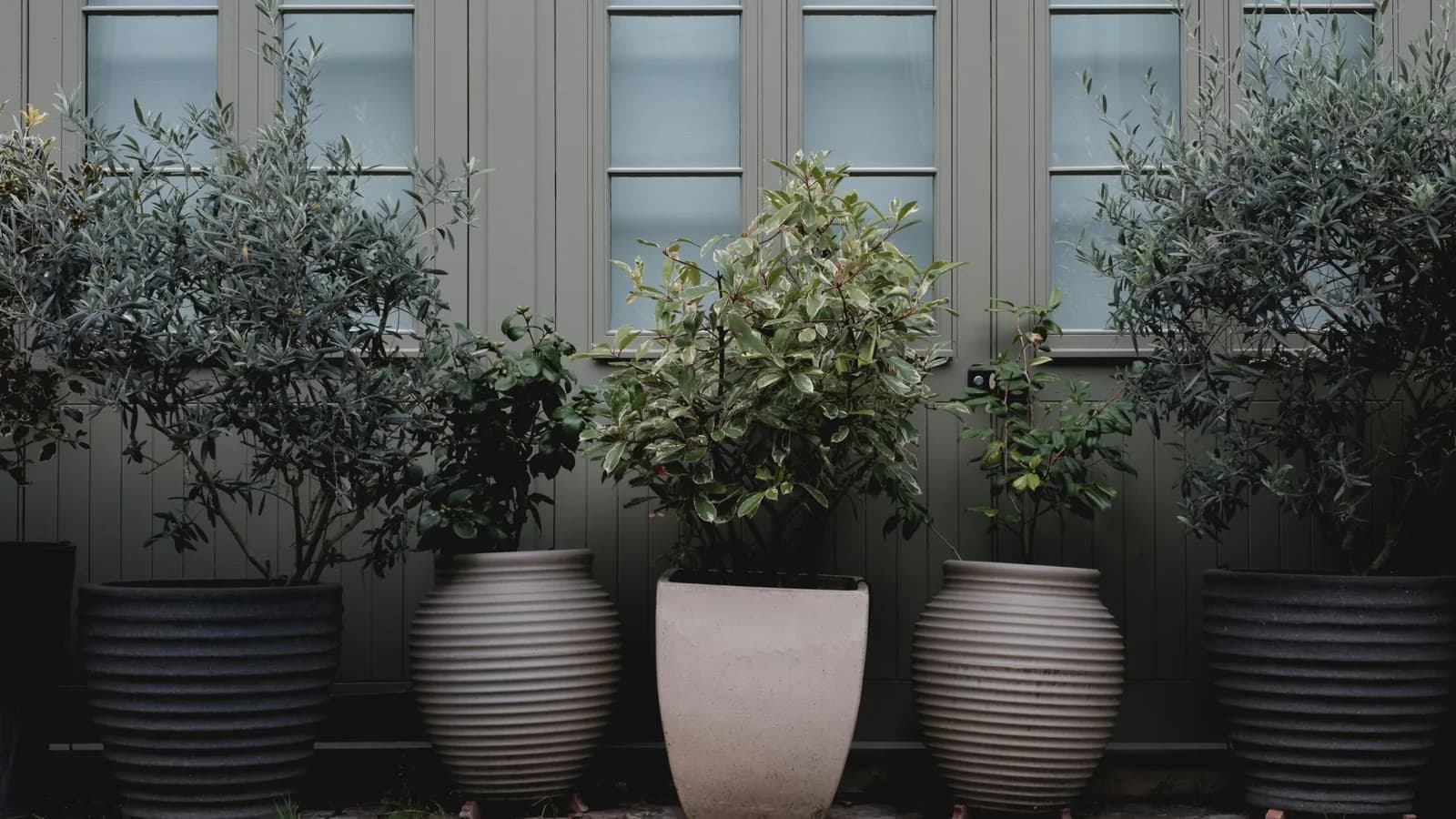
Containers let the strongest winter plants stand where they will be seen: by the door, at the end of a view from the kitchen, in the corner of a terrace visible from the sitting room. The RHS advice on winter containers makes two practical points. Plants grow very little in winter, so start with good sized plants that make an impact from the beginning. Position containers where they will get as much light as possible through the winter months, to keep foliage green and healthy.
The same guide describes evergreen shrubs as a good focal point in a large container. The container itself can be chosen to suit the evergreen it holds, in weathered granite, charcoal stoneware or riven slate. A single substantial evergreen in a fine container, set where it is seen every day, often does more for a winter garden than a border full of plants that rest underground until spring.
Why plan it now, at the end of September?
Because the planting season is about to open for planting in the ground. The RHS gives late October and early November, or March, as the ideal time to plant conifers, and between autumn and early spring as the ideal time to plant trees, whenever the soil is not waterlogged or frozen. A composition decided now can be in place before the days shorten in earnest.
There is a second reason. The garden is still full, which makes it easy to see what will vanish. Walk round it this week and note which plants are deciduous, which are herbaceous and which will hold their shape. What is left on that list is the winter garden as it stands.
Where do people go wrong?
One mistake is adding winter interest as small seasonal pots of bedding, which help briefly but do not change the structure of the garden. Another is placing evergreens where they are seen only from the far end of the lawn, when winter views are mostly from the house. A third is forgetting light: a container tucked into a shaded corner in winter will look tired long before spring.
When is this not the answer?
If the garden is designed as a summer garden for a house that is closed up in winter, there may be little reason to invest in winter structure. If the main view from the house is already held by a fine tree, hedge or wall, a single scented plant by the door may be all that is needed. And for gardens with a large planting scheme, the structure may be better solved in the ground with a garden designer than in containers alone.
Where should you begin?
Stand at the windows you use most in winter and look out. Mark where the eye lands, and whether anything there will still be standing in January. Those points are where a winter composition earns its place. The gallery shows evergreen and conifer compositions in their settings.
The studio gardens are in Linby, Nottinghamshire. Appointment only, by design. You can write to us through the enquiry page to talk about your garden through the winter months.