Why should the setting decide the tree?
A specimen tree is chosen to be looked at. It usually stands alone, in a container, in the most visible place in the garden. Because it carries so much of the composition, the wrong choice shows quickly. A tree that sulks in a draughty corner, scorches in full sun or swamps the space within a few seasons is a disappointment that no container can rescue.
So we start with the place and leave the plant until later. The light through the day, the wind that crosses the space, the height of the walls around it and the view from inside the house tell you more about the right tree than any catalogue description.
What does the RHS suggest weighing first?
The RHS guide to trees for smaller gardens puts it plainly: height and spread is probably the most important factor. To avoid planting a tree too large for its site, it suggests drawing a scale plan and plotting the size of the tree at maturity. The same guide recommends, where there is room for only one tree, looking for one with more than one season of interest.
The RHS tree growing guide adds the question of evergreen or deciduous. Trees that keep their leaves hold a consistent appearance through the year and are good for winter interest and for screening overlooking buildings. Deciduous trees bring autumn colour and let more light into the garden in winter. Its conifer growing guide carries a useful warning for anyone reading a plant label: many labels state the size after 10 years, so it is worth checking the eventual height as well.
For trees kept in containers, the RHS guide to growing trees in containers advises avoiding fast growing, large or vigorous trees, which start to look leggy as they struggle in too small a root space.
How do the main specimen trees differ in character?
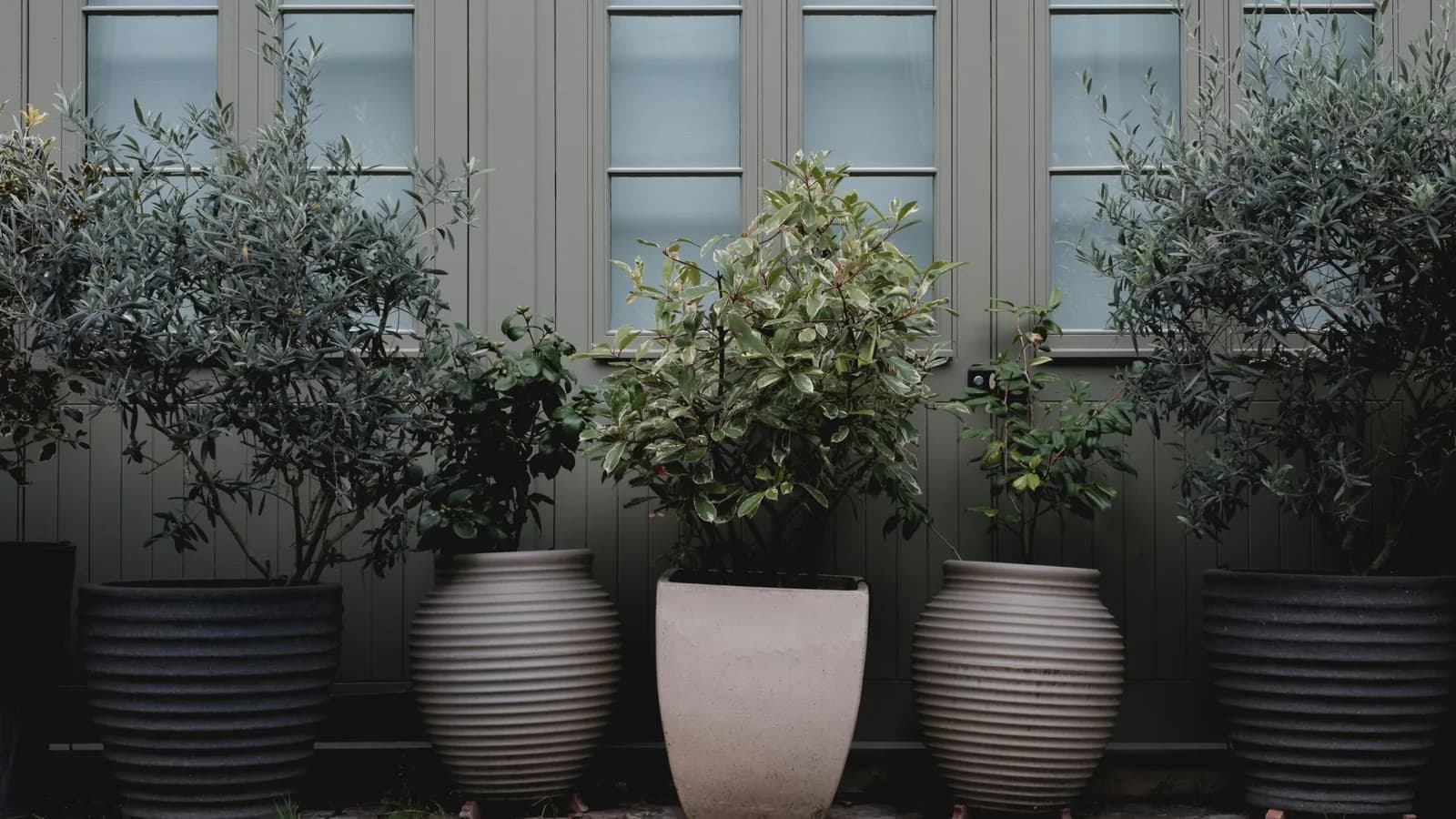
Our compositions centre on four kinds of tree, and each asks something different of its setting.
| Tree |
Character |
What the setting needs to offer |
| Japanese maple |
Fine leaves, layered branches, autumn colour |
Shelter from strong winds; partial shade for variegated forms, some sun for red and purple leaves |
| Olive |
Silver foliage, a gnarled trunk with age |
A sunny, sheltered site away from cold winds, and well drained soil |
| Pine |
Needles, an irregular outline, a sense of age |
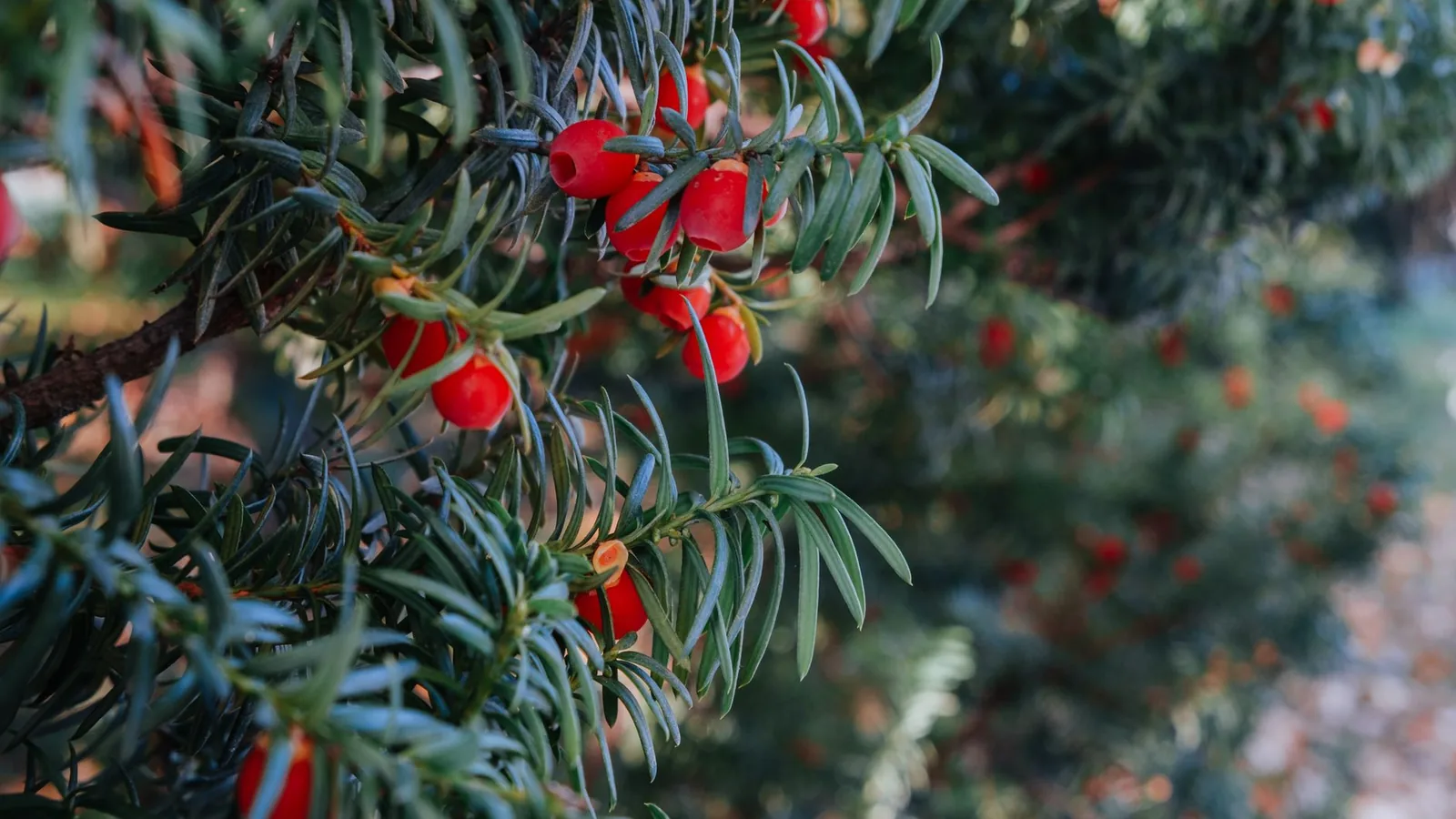
Copes better with wind and sun than broad leaves |
| Clipped evergreen conifer |
Firm, upright structure all year |
A position where its outline can be read against a wall or sky |
The detail behind the maple and olive rows, and the pine row's tolerance of wind and sun, comes from the RHS. Its Japanese maple guide says the trees are hardy but do best in a spot sheltered from strong winds, that red and purple leaved cultivars need some sun to develop their dark colour, and that variegated forms need partial shade so the afternoon sun does not scorch them. The RHS olive guide asks for a sunny, sheltered site away from cold winds, and notes that because olives rarely fruit in the UK they are best chosen for their shape or foliage. On pines, the RHS advice on roof gardens and balconies explains that plants tolerant of wind and sun tend to have modified leaves, needles among them.
Why decide at the end of summer?
Early September is a good moment to look. The trees in the garden are in full leaf, so you can see how much light a canopy takes and how its shadow falls across a terrace. The sun is lower than in July, which shows where shade will sit as the year turns.
It is also the right point in the calendar. The RHS growing guide gives the ideal time to plant all trees as between autumn and early spring, whenever the soil is not waterlogged or frozen, and its maple guide suggests planting from early autumn through winter. A decision made now leaves time for the container to be made and the tree to be placed as that season opens. Olives are the exception, since the RHS prefers spring for planting them in the ground.
Where do people go wrong?
Most often by falling for a tree before looking at the place it will live. A maple bought for its colour and set on an open, windy corner is prone to leaf scorch, however beautiful its container. An olive needs the sun the RHS asks for, and a shaded north wall denies it that.
The second mistake is scale, in both directions. A small tree on a large terrace looks lost, and the instinct is to compensate with a very large container. The RHS advises against putting a small tree in a very large container, and suggests potting up in stages to a final container of about 45cm (18in) as a minimum. A substantial setting usually needs a substantial specimen, not an oversized pot around a young one.
The third is reaching for size alone. The RHS conifer guide notes that semi mature plants are harder to establish and need extra care in planting and watering. A larger tree gives presence on the first day, but only if its care in the first seasons is planned for.
When is this not the answer?
If the space is deeply shaded by a building all day, or the only position available is a narrow passage, a specimen tree may simply be the wrong plant. Clipped evergreens, ferns or a wall planting may serve the place better. If the tree is to go into open ground close to the house, the RHS points to its separate guidance on trees near buildings, and that question belongs with a qualified arborist or surveyor rather than a planter studio. And if there is no one to water a container through a dry summer, a tree in the ground may be a kinder choice than one in a pot.
Where should you begin?
Stand where the tree would go at different times of day and note the light, the wind and what you see from the house. Those notes settle most of the choice before any tree is named. The gallery shows acers, olives and conifers in their settings.
The studio gardens are in Linby, Nottinghamshire, and visits are by appointment. Appointment only, by design. You can write to us through the enquiry page to talk about your space.